
Article Summary
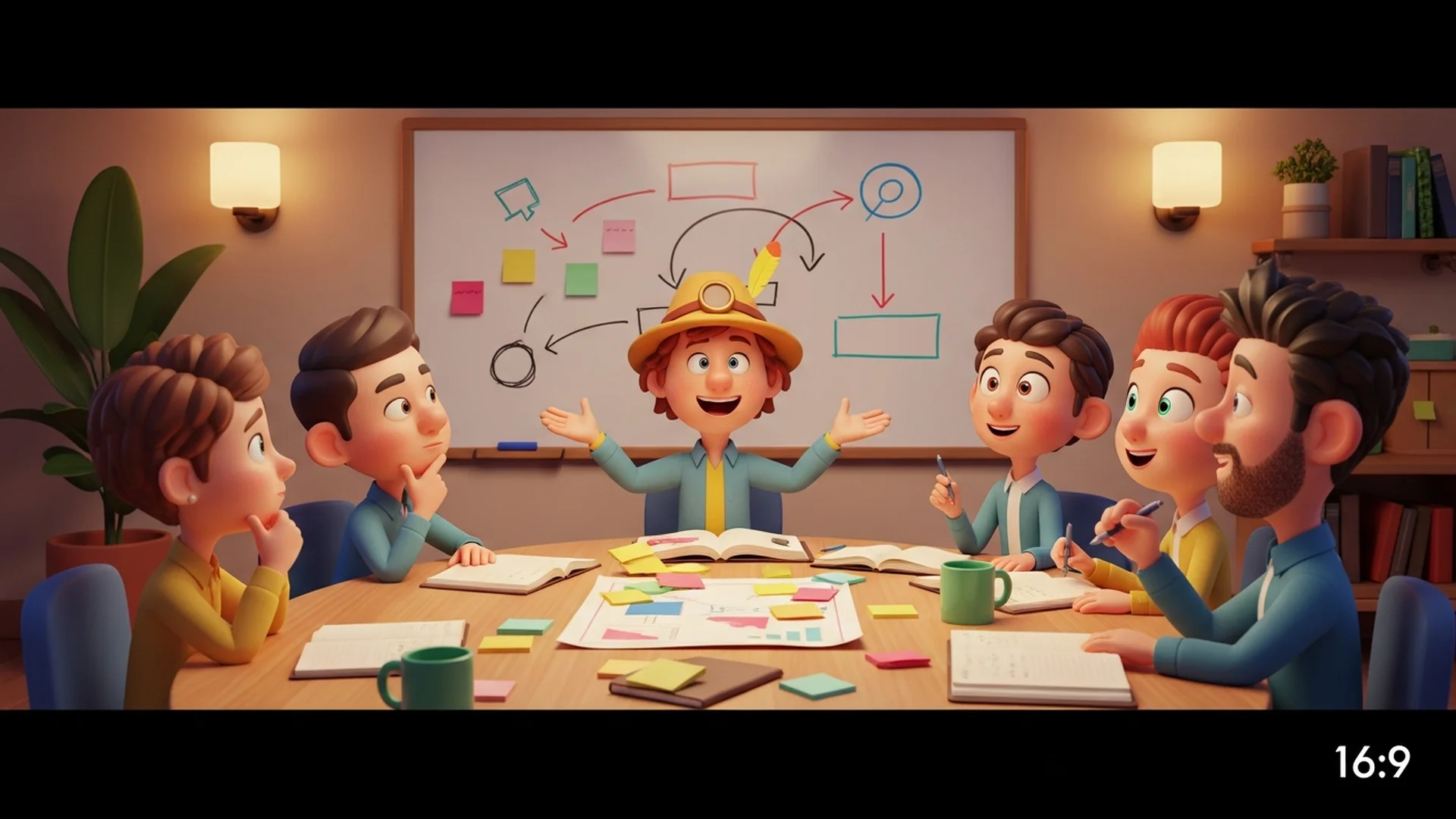
Storytime: What Is a Sprint Retrospective?
A sprint retrospective is a recurring meeting held at the end of a sprint within the Scrum methodology. It aims to give the team an opportunity to reflect on the past sprint, learn from their experiences, and identify ways to improve their work.
It's a key moment for the team's self-assessment and for fostering continuous improvement of the process.
OK, but What Does That Actually Look Like?
Before getting into the details, it's crucial to emphasize that the sprint retrospective is an opportunity for the team to self-assess and make improvements, without focusing on individuals or looking for someone to blame.
It fosters collaboration, learning, and collective commitment toward continuous improvement of the development process.
The Retro should be viewed through the lens of our cultural pillars:
Self-governance: the process is managed by the Scrum methodology, Wholeness: the Retro allows people to express what they truly and deeply feel in a supportive and candid environment, Evolutionary purpose: by having the cards in hand and embracing the Project's purpose as their own, the team naturally, intelligently, and methodically makes it evolve.
Here are the main characteristics and steps of a sprint retrospective:
Timing
The retrospective takes place at the end of each sprint, usually right after the sprint review, before starting the next sprint. It ideally runs for a limited duration, typically between 1 and 2 hours for a two-week sprint.
Participants
All members of the Scrum team are present, including the Scrum Master, the Product Owner, and the development team members.
Objective
The main objective of the retrospective is to enable the team to continuously improve by identifying what worked well, what can be improved, and the concrete actions to take for the next sprint.
Format
There are several formats for conducting a sprint retrospective. Among the most common are the "3 classic questions" (what worked well, what could be improved, what actions to take), "Start, Stop, Continue" (what should be started, stopped, continued), or "stars and deltas" (positive points, negative points to correct).
Flow
During the retrospective, the team examines the events, practices, interactions, and results of the previous sprint. They share their observations, ideas, and suggestions, generally using visual tools like whiteboards, sticky notes, or online collaboration tools. The emphasis is on transparency, trust, and honesty to foster an open and constructive discussion.
Actions and Planning
This is arguably the most important part, because this is the element you'll track from sprint to sprint to measure and monitor improvement.
At the end of the retrospective, the team identifies concrete actions to take to improve their work during the next sprint. These actions are recorded and tracked in subsequent retrospectives.
After the Retrospective
You should come out with a plan like the one below and you must track progress over time -- without this, the retrospective is only partially valuable.
Areas for Improvement Actions to Take Deadline Owner Criticality Progress Results Tracking Notes/Comments Item 1 Action 1 1 week Owner 1 High In progress Improvement observed Item 2 Action 2 2 weeks Owner 2 Medium Completed Issue resolved Item 3 Action 3 2 days Owner 3 Low Pending Add comments
Any Tips for Running a Great Retro?
Here are some practical retrospective methods you can use. Some require more preparation -- the first two are the most common.
Of course, the designated Scrum Master serves as the session facilitator.
A personal tip: regardless of the workshop, it's always a good idea to start with an "IceBreaker" to connect everyone's energy and get into the right mindset before diving into the workshop.
Here's a typical flow:
Start the workshop with an Ice-Breaker, Ask each participant to individually respond for a set duration by placing sticky notes in each section, The Scrum Master facilitates the debrief based on the material produced, From the elements identified, an action plan must be formalized with clear actions, identified owners, and reasonable deadlines. Of course, this plan will be tracked over time.
The 3 Classic Questions -- The Easiest Method
Input:
The Scrum Master will ask the following questions:
What worked well during this sprint? What could be improved? What concrete actions can we take to improve?
You can use a whiteboard, sticky notes, tools like Miro, or others.
You create 3 columns and everyone places their ideas in each column.
You can also do it verbally if you feel comfortable.
Output:
You should have:
A solid summary during the final recap, An action plan.
What Worked Well During This Sprint?
This question aims to identify the positive elements, notable achievements, and aspects of the sprint that were successful. The team is encouraged to share what went well, the successes they encountered, the practices that were effective, and of course, to celebrate.
This can include specific achievements, goals met, positive results, process improvements, or fruitful collaborations.
Here are some questions:
What were the notable achievements or successes of the team? Which practices or processes were effective and worth highlighting? What were the strengths of collaboration between team members?
What Could Be Improved?
This question invites the team to identify problems, obstacles, or weaknesses encountered during the sprint. The team is invited to share their difficulties, the challenges they faced, and the areas where improvements are needed.
This can include communication problems, delays, errors, technical obstacles, or gaps in work practices.
Don't hesitate to voice what bothered you -- it's for the good of the Project.
Here are some questions:
What difficulties were encountered or what recurring problems arose? Are there processes, tools, or obstacles that hindered productivity? Are there areas where the team could improve in terms of communication, skills, or coordination?
What Concrete Actions Can We Take to Improve?
This question focuses on the practical actions the team can take to resolve identified problems and improve their work during the next sprint. Team members are encouraged to propose solutions, improvement ideas, and concrete commitments.
These actions can include process adjustments, changes in work methods, additional training, experiments, or changes in collaboration.
Here are some questions:
What specific solutions or improvements can we implement? How can we capitalize on the strengths identified and mitigate weaknesses? What commitments can we make individually and collectively for the next sprint?
Start, Stop, Continue
Overview
Giving and receiving feedback can be difficult and intimidating. It's hard to look back on a quarter or even a week and classify a set of decisions as "positive" and "negative."
The Start Stop Continue framework was created to make it easier to reflect on your team's recent experiences. It's a simple but powerful tool that allows individuals and teams to decide what to change going forward.
To use the Start Stop Continue framework, the team divides their activities and decisions into three categories:
things they should start doing, things they should stop doing, and things that should continue to be part of their processes.
The Questions to Ask
Start - What should you start doing? These are activities and behaviors likely to improve your processes, reduce waste, and have a positive impact on how the team operates. Think about both technical and behavioral elements that could fall into this category. What tools should you start using? Is there a communication style that could work better for your team?
Stop - What should you stop doing? These activities and behaviors may be ineffective, unnecessary, or have a negative impact on how the team operates. Again, it's important to consider both technical and behavioral elements. Is the team using a tool that isn't working? Is there a meeting style or communication method that isn't working?
Continue - What should you keep doing? These are activities and behaviors you've tried and enjoyed, but that aren't yet part of your core processes. Take stock of the tools and methods you've experimented with since the last review cycle. What do you want to continue?
On Miro
Here's the link to the Miro template that will help you use this method.
What So What Now What
The "What - So What - Now What" retrospective method is a structured approach that allows the team to reflect on an event, situation, or project, draw lessons from it, and plan actions for the future.
What: In this phase, the team examines the facts, events, and activities of the past sprint objectively. The goal is to share information factually, without passing judgment.
The team answers the question: "What happened during the sprint?"
So What: In this phase, the team analyzes the implications, impacts, and consequences of the identified facts and events. The goal is to explore the reasons behind these events and understand their significance.
The team answers the question: "What does this mean for us as a team?"
Now What: In this phase, the team identifies concrete actions to take to improve work and future results. The goal is to generate ideas, formulate solutions, and define specific action plans.
The team answers the question: "What actions will we take going forward?"
It's also worth noting that this method is also known as "What Went Well, What Could Be Improved, What Will We Do Differently" or "WWW, EBI, WWD" in English.
To use it, you can use the Miro template and duplicate it.
4L
No, it's not the famous Renault car but rather a retrospective method that focuses on four key aspects: Liked, Learned, Lacked, and Longed For.
This method allows the team to reflect on their past experience, identify positive points, learnings, gaps, and aspirations for the future.
By focusing on what was liked, learned, lacked, and longed for, the team can identify specific actions to take to optimize their work and achieve better results going forward.
Liked: In this phase, the team shares what they liked or appreciated during the past sprint or event. This can include successes, moments of fruitful collaboration, achievements, best practices, or any other positive aspect. The team highlights strengths and encouraging aspects.
Learned: In this phase, the team reflects on the learnings and lessons drawn from the past experience. This can include new skills acquired, increased knowledge, challenges overcome, observations about the work process, or any other relevant learning. The team shares the important lessons they've gained.
Lacked: In this phase, the team identifies elements that were missing or didn't meet expectations during the past sprint or event. This can include gaps, recurring problems, weaknesses, difficulties encountered, or any other negative aspect. The team identifies areas that require improvement or special attention.
Longed For: In this phase, the team shares their aspirations, desires, or expectations for the future. This can include improvement proposals, wishes for changes, ideas to make work more efficient, or any other aspect the team wants to focus on for the next sprints. The team expresses their positive expectations for the future.
To use it, you can use the Miro template and duplicate it.
Treasure Island / Sailboat
Personally, this one's my favorite, and you can find some interesting variations.
The "Sailboat" method is a visual approach that allows the team to reflect on the strengths and weaknesses of their work, as well as the obstacles and opportunities ahead. This metaphor uses a sailboat to represent the project and a treasure island to represent the team's goal.
Here's how this method works:
The boat: The boat represents the project or the team's objective.
The sails: The boat's sails represent what drives the Project forward -- in other words, the team's or the project's strengths and positive elements. Ask the team to reflect on what's working well, achievements, successes, or specific skills that have been beneficial. Each identified strength is represented by a sail attached to the boat.
The anchors: The anchors symbolize the drag -- what's holding the boat back from moving forward well. These are the weaknesses, obstacles, or elements holding back the team or the project. This can include recurring problems, challenges to overcome, or difficulties encountered. Each identified anchor is represented by an anchor symbol placed beneath the boat.
The wind: The wind represents the opportunities or external factors that can help the team progress toward their goal. Ask the team to reflect on present or upcoming opportunities, available resources, or any situation that can support their work. Each opportunity is represented by arrows indicating the direction and intensity of the wind.
The destination: Finally, ask the team to reflect on the final destination or goal they want to achieve. This is represented by the treasure island. This helps keep the big picture and long-term objective in sight.
Once all these components are in place, the team can discuss the various elements of the sailboat, share their ideas and perspectives, and work together to develop action plans aimed at strengthening strengths, resolving problems, and seizing opportunities.
This visual approach facilitates team engagement, encourages discussion, and stimulates creativity for continuous improvement of work.
To use it, you can use the Miro template and duplicate it.
Articles in this series "Morpheus"
This article is the 8th in a series of 11 on project methodology, from pre-sales through to invoicing.
- Project Morpheus: Pre-Sales
- Morpheus: Introduction to Specification Workshops
- UX/Design Thinking: The "Double Diamond" Method
- Introduction to Application Architecture
- Morpheus: Cost Estimation
- Project Morpheus: The Kick-Off
- Morpheus: The Steering Committee
- Morpheus: How to Run a Sprint Retrospective?
- The "Project Studio"
- The Agile Methodology
- Morpheus: UX/Design Thinking, Facilitation or the Art of Running a Great Workshop

Yaniv Adjedj
CEO Groupe Reboot Conseil & Lamalo
Fondateur et capitaine des Sociétés Reboot Conseil & Lamalo, Yaniv donne le cap depuis Strasbourg avec une vision claire : bâtir un cabinet de conseil IT, IA & Cyber - où autogouvernance, transparence et ambition ne sont pas que des mots. Diplômé de l'Université Paris Cité, il mêle leadership et passion tech au quotidien.
LinkedInSimilar articles
Newsletter
Get our best articles every month.
Go further
Article
Comment choisir son cabinet de conseil IT à Strasbourg
Guide honnête pour choisir un cabinet de conseil IT à Strasbourg et dans le Grand Est : les 4 critères qui comptent vraiment, les pièges à éviter et les bonnes questions à poser.
ArticleComment on a connecté notre IA à notre logiciel financier — et pourquoi ça change tout!!
Articlen8n, c'est quoi ce truc ?
Père Castor, raconte-moi n8n n8n (prononcez « n-huit-n » ou « nodemation » si vous voulez faire classe). C'est un outil qui permet de connecter vos...
ArticleComment l'IA révolutionne le marketing (sans vous remplacer)
L'intelligence artificielle s'est invitée dans le quotidien des marketeurs à une vitesse record. En quelques mois, des outils comme ChatGPT,...
ArticleGrille d'évaluation des besoins de formation IA : Le guide pour DRH et Managers
Le risque ? Créer une \"illusion de compétence\" tout en laissant les véritables lacunes stratégiques se creuser. La solution est pourtant simple et...
ArticleLa France a-t-elle déjà perdu la bataille de l'IA ?
À lire avec la voix de Stallone : « plus de puces, plus de data, plus de milliards, le maître du monde ». Je viens de regarder le dernier numéro du...