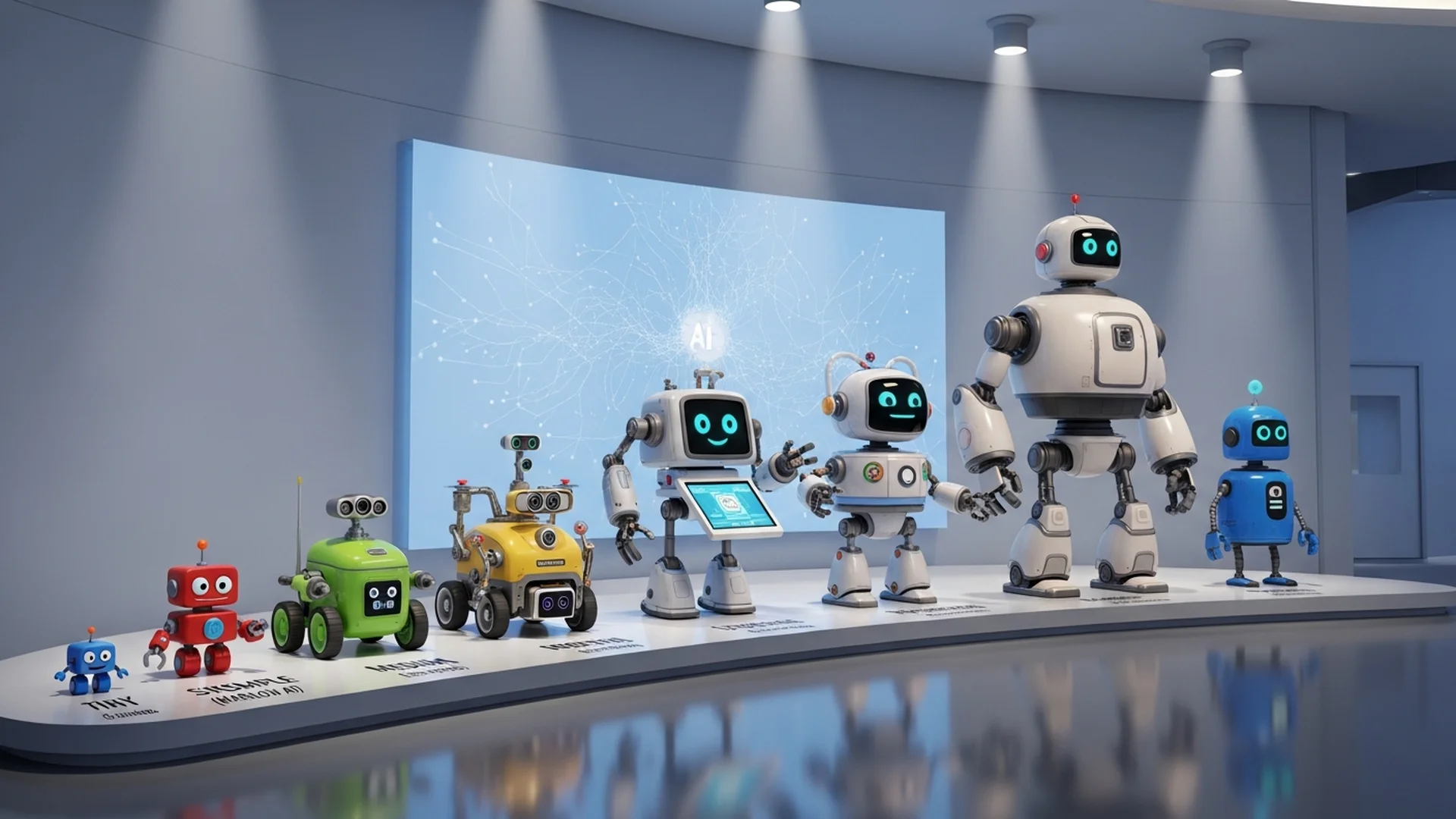

I recently had the chance to read a graphic novel drawn in 2019, Intelligences Artificielles: Miroirs de nos vies, which explained how AI works through simple concepts. I brought it to the office, and since then, the book has been passed from hand to hand.
After reading this book, I had the idea of writing a concise article about the different kinds of AI that exist.
Narrow AI (or Weak AI)
This is undeniably the most common type of AI today. It is designed to perform a specific task. It is often contrasted with the concept of general AI, which we'll cover in the next section.
For example, a voice assistant like Siri or Alexa is a narrow AI because it specializes in understanding and generating speech.
ChatGPT is also an example of narrow AI because it specializes in language processing, has no intentions of its own, is limited to what it has learned, and does not learn in real time.
Even AlphaGo, which has mastered the game of Go inside out, is a narrow AI.
General AI
This is a form of AI that would have all the cognitive abilities of a human. It's the form of AI that both fascinates and frightens us.
This means it could perform any intellectual task that a human being can do. At this stage, we have not yet reached this level of AI, but science fiction is full of examples of this type, such as in Asimov's books or Data from Star Trek.
Superintelligent AI
This is a hypothetical form of AI that would far surpass human intelligence in almost every domain, from scientific activities to daily life. It would be capable of autonomously improving its own abilities. To get there, we would first need a general AI capable of outperforming humans in all areas.
This is what Skynet proposes in the movie Terminator.
Rule-Based AI
This is an older approach to AI where machines are programmed to follow specific instructions and rules to solve problems, like an expert medical system that diagnoses diseases. It was relatively common in the 1980s and 1990s.
Machine Learning
Machine Learning is a subcategory of AI where machines learn from data. Instead of being explicitly programmed, they use data to make predictions or decisions. These are very common AI systems today.
The recommendation algorithms from Netflix or Spotify that suggest movies or songs based on your past preferences are examples of Machine Learning.
Deep Learning
This is a subcategory of Machine Learning based on structures called neural networks. These structures are inspired by the human brain and are particularly effective for tasks such as image or speech recognition.
Some examples:
- Google Photos automatically identifying and classifying images based on people or places
- Our smartphones using facial recognition
Reactive AI
These are machines that do not store any memory of their past experiences. They analyze situations and react accordingly. Computer chess games, like IBM's Deep Blue, are examples of reactive AI, as are video games where AI opponents react to the player's actions in real time.
Memory-Based AI
Unlike reactive AI, this form of AI can make decisions based on past experiences thanks to a memory of those experiences.
We're quite familiar with them today, since customer service chatbots are examples of this type of AI: chatbots can remember your previous interactions and reference them in later conversations.
Theoretical or Symbolic AI
This approach has recently come "back into fashion" because it shows great promise and is far less energy-hungry than so-called narrow AI. We'll see how it develops.
This type of AI relies on manipulating symbols and concepts to solve problems, rather than numerical data.
It is mainly used in mathematical problem-solving programs that manipulate symbols and equations to find solutions.
Evolutionary AI
These use algorithms inspired by biological evolution, such as natural selection, to find solutions to problems.
They can be found, for example, in algorithms that "evolve" to find the best design for an object, such as an airplane engine component.
Conclusion
These different types of AI help us understand the possibilities available to us. Some AI is still at the experimental stage, but many are already part of our everyday lives.
It's up to us to make something of them, but always in the right way!

Yaniv Adjedj
CEO Groupe Reboot Conseil & Lamalo
Fondateur et capitaine des Sociétés Reboot Conseil & Lamalo, Yaniv donne le cap depuis Strasbourg avec une vision claire : bâtir un cabinet de conseil IT, IA & Cyber - où autogouvernance, transparence et ambition ne sont pas que des mots. Diplômé de l'Université Paris Cité, il mêle leadership et passion tech au quotidien.
LinkedInSimilar articles
Newsletter
Get our best articles every month.
Go further
Article
Comment on a connecté notre IA à notre logiciel financier — et pourquoi ça change tout!!
Articlen8n, c'est quoi ce truc ?
Père Castor, raconte-moi n8n n8n (prononcez « n-huit-n » ou « nodemation » si vous voulez faire classe). C'est un outil qui permet de connecter vos...
ArticleComment l'IA révolutionne le marketing (sans vous remplacer)
L'intelligence artificielle s'est invitée dans le quotidien des marketeurs à une vitesse record. En quelques mois, des outils comme ChatGPT,...
ArticleGrille d'évaluation des besoins de formation IA : Le guide pour DRH et Managers
Le risque ? Créer une \"illusion de compétence\" tout en laissant les véritables lacunes stratégiques se creuser. La solution est pourtant simple et...
ArticleLa France a-t-elle déjà perdu la bataille de l'IA ?
À lire avec la voix de Stallone : « plus de puces, plus de data, plus de milliards, le maître du monde ». Je viens de regarder le dernier numéro du...
ArticleL'IA : l'Impératif de Gouvernance Ultime
Soyons clairs : si vous dirigez une organisation de taille significative aujourd'hui, la complexité des données, leur volume, leur vitesse de...