
Article Summary
AI is already a hugely complex topic because there are a thousand ways to approach it:
Impact on our society, Impact on the workplace, How it works, Legal issues, The endless stream of tools, Privacy, HR, Marketing, and the list goes on.
On top of that, we are Reboot, and we made a deliberate choice to address everything, both on the technical and strategic fronts, and on top of that we're building a startup to sell AI products. This significantly raises the difficulty level.
From experience, if you choose to talk about:
Training, people will only see you as a training provider. Strategic consulting, they won't come to you for AI projects that require development. Development, they won't see you on organizational matters. Your products, they won't see you on the consulting side.
So how do you communicate everything without being pigeonholed, and instead be seen as the big picture player?
It took me a while to find the right pitch, so I'm sharing my findings and I truly hope this will help you.
Like any sales approach, there's a prerequisite: the most important thing isn't to talk, but first to get the other person talking so you can then find the right words.
Here's my method, hoping it helps!
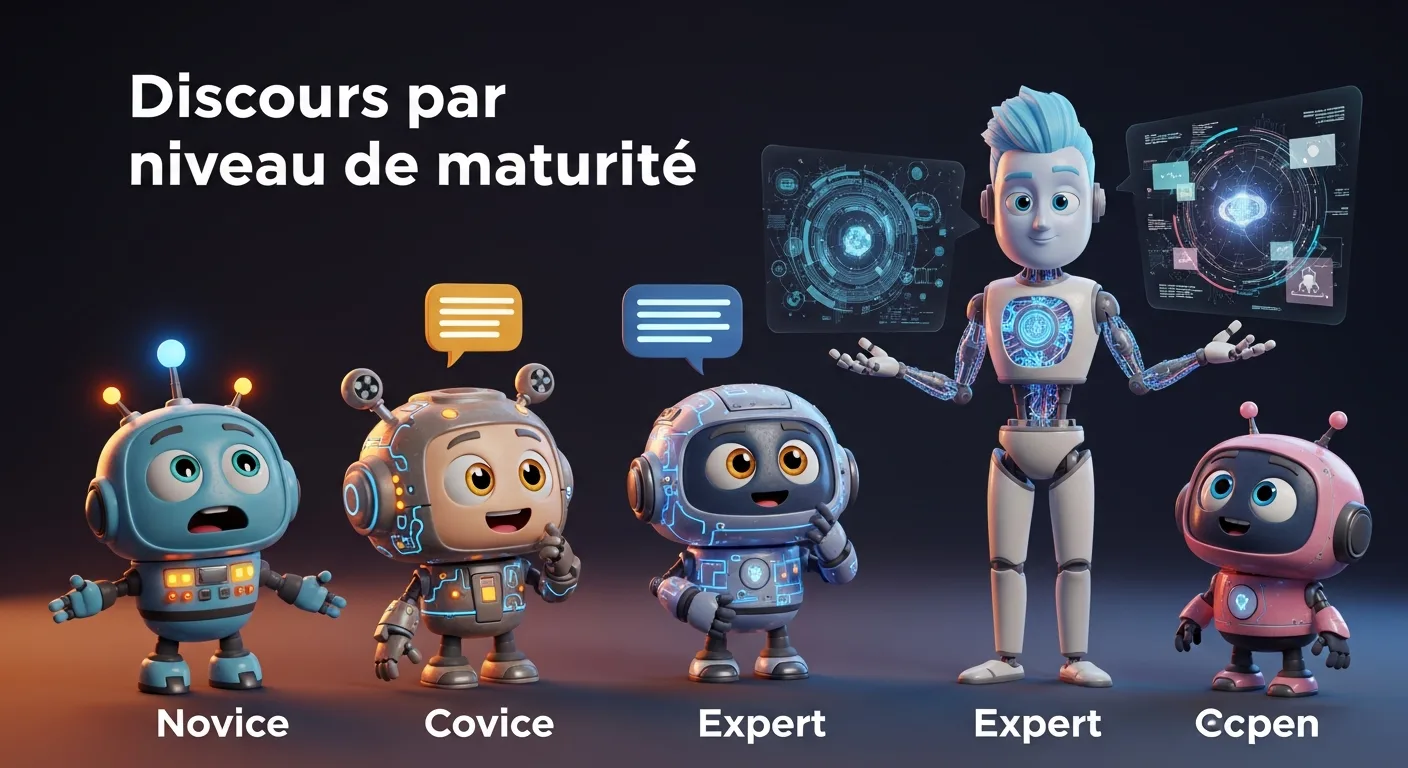
Pitch by Maturity Level
General Principles (must-read)
When using this pitch framework, the most important thing is to assess the maturity level of the person you're speaking with, so you can address their current level and the next two levels they need to reach. There's no point in talking about the endgame; it's not even an option. You need to let the questions come naturally. If they don't have the questions yet, they will; it's only a matter of time.
Regardless of the approach, if you want AI to be adopted by your prospects, the positive effects must be visible and fast. You therefore need to identify a "domain" within your prospect's organization that can have a high impact. A domain can be an important cross-functional project or a specific team. Ideally, within this domain, you have a member of the executive committee who is personally and operationally involved.
Generally, these domains are very closely tied to sales or marketing because they produce visible numbers, so I recommend steering your pitch toward results and impact.
Another point: the more you advance in the AI world, the more you'll assume your contact has probably tried AI tools just like you have. Spoiler alert: THAT'S NOT TRUE! Most people don't have your level of knowledge. They have a vague idea or have dabbled a bit but never in a truly professional way, so don't hesitate to ask questions to find out how far the person has gone.
Not everyone knows what Perplexity, NotebookLM, Gamma, or Fireflies are. Far from it!
With these principles in mind, adapt your pitch accordingly.
Identifying Your Contact's Maturity Level
Initiation
Context: The company is just getting started. It's exploring, raising awareness, recruiting experts, identifying use cases. Some people are using AI in its free version without any prerequisites or awareness training.
You start by selling training with a structured approach:
A general introduction to AI for acculturation, regardless of the format. It can be a webinar, in-person session, video call... A hands-on workshop to break the ice with AI, which can follow the general introduction, A deeper dive for more mature participants with a focus on privacy and confidentiality issues.
You schedule a follow-up right after the training sessions to kick off the next steps.
Expansion
Context: First pilot projects, desire to demonstrate AI's value.
Your prospects have already taken initiatives by subscribing to tools and running a few POCs. Now they want to expand and bring others along so those people can start getting acquainted with AI, because they're convinced of its benefits (or because it's good for their careers).
So you need to offer training for beginners, take on the use cases they bring to you, while being aware that initiatives at the company level are scattered and unstructured. In other words, other departments may also want to expand, and each department has AI initiatives without trying to coordinate.
This means that in terms of prospecting, you can talk to multiple departments so you have a global view of the company. This can also fit into an audit (which I can conduct as an expert with France's BPI on innovation matters).
After running several POCs or even projects, the company will at some point realize it needs to realign everyone and take a more centralized approach.
Alignment
Context: AI is structured and aligned with the company's overall strategy.
You've understood that AI shouldn't exist in a silo. Our value is helping make AI a cross-functional strategic lever. This requires clear governance, coherent roadmaps, and a data culture that permeates the entire organization. Together, we integrate AI where it will make the greatest difference.
So you need to bring people from the previous stages up to speed, but this time with a global, centralized vision and with habits starting to form.
The goal of this phase is to start thinking big and realizing that the company will need to have a company-wide dialogue rather than relying on a small group of AI hyperspecialists.
You'll need to build a vision, a charter, recommendations, and probably even begin a reorganization that can be either cross-functional or dedicated. Cross-functional by creating an AI committee whose members are spread across the entire company. Dedicated by having an AI factory, for example, that serves the whole company. Of course, it can also be a hybrid approach.
Optimize
Context: AI optimizes operations, costs, and productivity.
The company is aligned on objectives with a roadmap, meaning projects are being executed. Like any project that matures, an optimization phase is necessary to go further.
This is the phase where, for example, you'll look into vectorizing all databases. It's also the phase where the company may choose to acquire GPUs and host its own AI models to meet its real needs without being weighed down by everything superfluous.
This is the phase where you start implementing KPIs on projects, such as ROI.
Nurture
Context: AI is customer-centric, enriching relationships and enabling personalization.
An AI that processes data is an AI that can learn to better optimize itself and therefore respond in the best possible way. It could even self-train. It would be able to deliver more personalization, and time is what makes this possible, since the more time passes, the more data accumulates.
Engagement
Context: AI transforms internal and external relationships in a proactive and predictive way.
The company is 100% committed to AI, optimizing processes, improving performance, streamlining, and simplifying complex things.
Externally, this has an impact because your usage becomes noticeable through improved quality of interactions. You're now engaging not just your operations but your brand, whether for hiring or for sales. You'll write books, give talks, host webinars, produce podcasts...
This must therefore be measured through KPIs for both internal and external outcomes that objectively track results.
Evangelization
Context: AI is at the heart of innovation. The company anticipates, surprises. People talk about you even when they're not employees.
This is the ultimate phase. Everything comes to you and everyone wants to contribute to your projects.
Ready-Made Questions
Maturity Phase Questions to Ask Initiate - Have you already organized AI training or awareness sessions within your company?
- Are some employees already using tools like ChatGPT or other AI solutions?
- Have you identified concrete use cases where AI could have an impact? Expand - Have you run POCs or deployed pilot projects around AI?
- Are these projects documented or shared within the company?
- Have other teams or departments initiated similar efforts on their own? Align - Do you have AI governance or a roadmap defined at the company level?
- How is AI integrated into your overall strategy?
- Have you set up an AI committee or a dedicated team? Optimize - Have you measured the impact (ROI, performance, efficiency) of existing AI projects?
- Are you using metrics or indicators to steer your AI initiatives?
- Are you considering optimizing your infrastructure (GPUs, data vectorization, model hosting)? Nurture - Are you using AI to enrich the customer relationship in a personalized way?
- Do you have data analysis tools to feed and train your AI systems?
- Is AI integrated into your user journeys or customer feedback management? Engage - Do you have AI processes that anticipate or predict internal or external needs?
- Are you measuring the impact of your AI projects on the customer or employee experience?
- Are you sharing your AI results externally (talks, books, podcasts...)? Evangelize - Is AI an integral part of your innovation DNA?
- Do others talk about your use of AI spontaneously?
- Are you approached for your AI initiatives without actively prospecting?
How to Talk About Reboot & Co Now?
You've identified your contact's maturity level; now you need to adapt your pitch to their reality.
There's no reason to talk about acculturation to a company at the engagement stage. Conversely, talking about agentic platformization to a company at the expansion stage will have no impact.
So you should, for instance, mention that you offer training at the engagement stage, but it should be a passing reference.
Everyone needs to develop their own techniques, but I believe that following the chronology gives any pitch added strength when you don't know where to start.
Here's my standard pitch:
Reboot was born in November 2020 with a project to create a startup studio. To do that, you need to generate a lot of revenue so you can take risks. Naturally, we turned to what we do best, with excellence: Consulting. That's how Reboot Conseil was born. We initially focused on IT consulting and then expanded our offering to include engineering and organizational consulting.
Our core business, which we love, is consulting. We can work on-site at your offices through staff augmentation, on projects from our own offices (in fact, half our team works from our premises), as expert advisors, and also as trainers, since we are a Qualiopi-certified training organization. This means you can use your training budget to work with us.
Our culture is Teal (based on Frederic Laloux's model) with 3 pillars: self-management, wholeness, and evolutionary purpose (I briefly explain without going into all the details). This is our foundation, to which we add our 6 values, including transparency, which means every Rebooter has access to salaries, revenue, profits, and the company's cash position... Why do we do this? It's simple: to build a startup studio, you need to enable intrapreneurs to actually be intrapreneurs, so you need to train them for that.
In September 2023, we decided to implement scaled Agile principles, and that's how we launched the Squad system: cross-functional teams of 6 to 12 people. We have Core Business squads that keep the business running, and Creator squads that can become full-fledged Reboot subsidiaries.
That's how in September 2023 we launched the creator squad, the AI Squad, whose role is to develop our dedicated AI capabilities. From September 2023 to March 2024, we built deep technical skills around AI, except we could only talk shop with specialists without properly meeting our contacts where they were.
Starting in March 2024, we stopped talking tech about AI and switched entirely to business cases and use cases. That's why I asked you all those questions upfront, so we can speak the same language, because our strength is being able to address everything related to AI: from introductory training all the way to strategic consulting to measure AI's impact on your organization, through building your AI solutions or advising on tool selection.
It's a topic we're passionate about and we've gone all in. We know what's coming in the next few years, and right now the market is very immature.
Everything is being impacted and we're living in a time similar to the Industrial Revolution: where human muscle was replaced by mechanical power, we're now supplementing our cognitive power with artificial intelligence. Everything will transform, and so we must consciously choose the direction we want to take on this topic. Paradoxically, the major challenge of AI is the human being at its center. Our children already know how to use it, while older generations will struggle more, creating a divide similar to the digital divide.
At this point, you need to take the use cases your prospect has mentioned and dive fully into them, explaining how Reboot can address them.
So that's what we can do through Reboot Conseil and Reboot Academy.
But that's not all!
Thanks to our expertise, we decided to create a subsidiary wholly owned by our company whose purpose is to commercialize our AI products. We secured the maximum BPI grant for this!
To create this startup, we started from observations we'd fully experienced ourselves:
There are countless AI tools on the market and it's hard to find your way, The market is in constant motion with new developments every day, making it difficult to keep up, AI tools tend to be single-task and can't chain a series of actions together, So you end up stacking AI tools, paying for a string of subscriptions, and it gets confusing. Especially since all those small costs add up and you end up paying quite a lot, And above all, privacy and confidentiality issues are not addressed at all.
That's why (!) we connected all the AI tools on the market to build a One-Stop-AI platform with an AI we designed that detects your intentions and selects the best AI tools to address your entire request, not just a single part of it.
What's also important is that you can choose your level of confidentiality based on your needs: being in a board meeting doesn't require the same level of confidentiality as running a general web search.
The other advantage of Sp0ton is its modularity and its ability to adapt easily to create custom use cases and/or products. For example, we built in record time a product that combines Fireflies (for video meetings) and Plaud (for voice notes and/or recordings in person or over the phone) while adding the importance of confidentiality.
This is only possible thanks to our technical architecture, which allows us to treat all AI tools as agents that I can assemble together like Lego blocks.
From there, we move to the demo, which starts with presenting Sp0ton's predecessor, which has existed since 2023, Reboot GPT, followed by the full Sp0ton demo. By the way, I systematically try to present Gandalf but in my opinion it still lacks fluidity in the demo. Then I continue:
Sp0ton can be integrated into your environment to become YOUR solution that you can customize and even co-build.
Regarding pricing, we realized several months ago that companies need to pay for appropriate usage, which is why we offer several options:
All base licenses are 5 EUR excl. VAT / user / month, which corresponds to a dedicated token allocation (depending on models used: 50 chats, 10 images, 1 minute of audio), For power users, we offer a credit-based model. For example, the company buys 1 million tokens for 1,500 EUR excl. VAT. We then track usage together over a 3-month period, and at the end we review together whether to continue with credits or set a flat-rate package.
There are also setup fees of 3,000 to 5,000 EUR excl. VAT. We can also include training to onboard your users to both the product and AI in general.
We also need to discuss together whether you'd prefer to host the solution on your own infrastructure or have us host it. One last thing: if you have specific customizations that aren't on our roadmap, we can build them, but through our consulting practice.
Conclusion
The pricing strategy reflects the time of writing this article and may evolve. The advantage of a product is that it speaks louder than consulting; the downside is that it overshadows consulting. Sp0ton is a card that will get you identified with this product, so it needs to be used the right way.
Enjoy

Yaniv Adjedj
CEO Groupe Reboot Conseil & Lamalo
Fondateur et capitaine des Sociétés Reboot Conseil & Lamalo, Yaniv donne le cap depuis Strasbourg avec une vision claire : bâtir un cabinet de conseil IT, IA & Cyber - où autogouvernance, transparence et ambition ne sont pas que des mots. Diplômé de l'Université Paris Cité, il mêle leadership et passion tech au quotidien.
LinkedInSimilar articles
Newsletter
Get our best articles every month.
Go further
Article
Comment choisir son cabinet de conseil IT à Strasbourg
Guide honnête pour choisir un cabinet de conseil IT à Strasbourg et dans le Grand Est : les 4 critères qui comptent vraiment, les pièges à éviter et les bonnes questions à poser.
ArticleComment on a connecté notre IA à notre logiciel financier — et pourquoi ça change tout!!
Articlen8n, c'est quoi ce truc ?
Père Castor, raconte-moi n8n n8n (prononcez « n-huit-n » ou « nodemation » si vous voulez faire classe). C'est un outil qui permet de connecter vos...
ArticleComment l'IA révolutionne le marketing (sans vous remplacer)
L'intelligence artificielle s'est invitée dans le quotidien des marketeurs à une vitesse record. En quelques mois, des outils comme ChatGPT,...
ArticleGrille d'évaluation des besoins de formation IA : Le guide pour DRH et Managers
Le risque ? Créer une \"illusion de compétence\" tout en laissant les véritables lacunes stratégiques se creuser. La solution est pourtant simple et...
ArticleLa France a-t-elle déjà perdu la bataille de l'IA ?
À lire avec la voix de Stallone : « plus de puces, plus de data, plus de milliards, le maître du monde ». Je viens de regarder le dernier numéro du...